
Disclaimer: The views and opinions expressed in the articles on this page are those of individual supporters. They do not necessarily reflect the official views or positions of Justice for Innocent Men Scotland (JIMS).
Government-Funded Misandry at Holyrood: The Festival of Politics and the “Rise of Misogyny”
On Thursday 21st August 2025, JIMS attended The Rise of Misogyny lecture at the Scottish Parliament’s Festival of Politics, chaired by Rona Mackay MSP with panelists Dr Leah McCabe, Katie Horsburgh, and Tazrian Tasmiah MSYP.
This event, funded by the Scottish Government (read: our taxes), was promoted as an academic discussion. Instead, it was a one-sided attack on men, a session openly shaming them simply for being men. What we witnessed was not education but state-backed misandry and misinformation.
Misogyny of the 1970s – Misandry of Today
The MSP chairing spent time talking about misogyny in the 1970s, as though nothing has changed in 50 years. This narrative is outdated and insulting. While we do not condone misogyny, Scotland in 2025 is not the same country it was in the 70s and 80s. Times have changed.
Today, the real danger is misandry. What is being normalised in government-backed events like this lecture is the idea that:
- All men are inherently misogynistic
- Men are automatically linked to racism and white supremacy
- Teenage boys who laugh at an inappropriate joke will “probably harm women in the future” (yes, that really is a quote from the event).
Women were presented as being in a permanent state of victimhood, always oppressed, always fearful, and apparently one step away from being attacked by men lurking around the corner. This is not empowerment. It is fear-mongering.
The Rise of the Manosphere – Misinformation and Fear
The panel painted the “manosphere” as a dangerous network, but their examples boiled down to little more than men using humour or language feminists dislike. They threw around the term incel as a derogatory insult, ignoring the reality that many young men no longer want to date because feminism has become frightening and because false accusations are a constant threat.
False allegations destroy lives. Yet this reality was brushed aside. Instead, young women are being conditioned to see oppression everywhere and to treat men with suspicion by default. It is teaching them that every interaction is political and every difficulty is part of a grand agenda against women.
One teenage boy in the audience asked a fair question: shouldn’t women on OnlyFans, who willingly sell their bodies online, take some responsibility for how they are treated? The panel fell silent and refused to answer. Instead, a short-haired woman from the audience declared, “It’s men’s fault anyway.” That summed up the mindset perfectly.
Pornography, too, was blamed solely on men, with women depicted as helpless victims, despite the countless women who openly say they are empowered by it and profit from it.
The Audience – An Echo Chamber and Indoctrination
The audience was packed. It was a sold-out event. The seats were filled not just with older, angry feminists glaring at anyone who didn’t conform, but also with young people, many clearly there on school trips. What's truly disturbing was that the MSP seemed on a mission to speak directly to those school pupils, as if the real goal was indoctrination from a young age. On the other hand - and this also sums up the agenda, one of the shocking moments was when Rona Mackay MSP was called out by one of her older supporters for not being “angry enough.”
This wasn’t debate. It was an echo chamber of rage.
The #MeToo Legacy – Witch Trials of the 21st Century
The panel’s language echoed the toxic aftershocks of the #MeToo movement. While presented as a force for justice, #MeToo - driven by angry feminists - has created a world where a man can now be imprisoned on a woman’s word alone.
This is not progress. This is regression, a return to the witch trials of the 1700s when hearsay and accusation were enough to destroy lives. Only this time, it is third-wave feminists playing the role of inquisitors, branding men guilty without evidence.
The Real Agenda – Conditioning the Next Generation
Perhaps the most worrying revelation was how far this ideology is being pushed into education. The panel and its supporters are shaping what our children are taught in schools, with organisations like Rape Crisis Scotland driving the agenda.
Girls are being conditioned from a young age to see themselves as victims, always oppressed, always under threat. Boys are taught to feel shame for simply being male. Many of us who are mother of sons, find it terrifying that our children could be labelled misogynists one day simply for laughing at a joke.
The Feminist Minority – Not the Voice of All Women
Third-wave feminists pretend they speak for all women. But the reality is - they don’t. Most women do not hate men. Most of us value manliness, chivalry, and traditional dynamics just as we embrace femininity.
This brand of feminism has nothing to do with equality. It is about hating men and gaining power. And it is being championed by the Scottish Government through events like this.
Where We Stand
The message from this Festival of Politics lecture was clear: men are to blame for everything. From humour, to sex, to porn, to women’s own choices, the finger always pointed at men.
I left early, feeling internally sick and embarrassed to have even attended such an event.
The SNP are pushing to make misogyny a hate crime. If they are serious about justice, then misandry must also be made a hate crime. Until then, what we saw at Holyrood was not progress, not politics, and not equality. It was state-funded man-hating.
At JIMS, we stand firmly against all forms of hate, including the rising tide of misandry that events like this promote. Our work is rooted in exposing wrongful convictions, challenging false allegations, and fighting for fair trials for men in Scotland who have been sacrificed to political agendas. We will continue to shine a light on these government-funded echo chambers and speak for the silent majority who believe in balance, fairness and true equality. This isn’t just about protecting men, it’s about protecting justice itself.
M.


From Witch Trials to “Justice” in 2025: Scotland Hasn’t Learned Enough
In 1704, Lilias Adie was accused of witchcraft in Fife. She never stood trial because she died in custody — broken by the weight of false accusation and a system that needed victims more than it needed truth. She was buried under a heavy stone to prevent her from “rising again.”
Today she is remembered as a tragic casualty of mass hysteria dressed up as justice.
Three centuries later, Scotland tells itself it is enlightened. Yet when we look at the reality of sexual offence (SO) trials in 2025, the echoes are deafening. The witch hunts never truly stopped - they just changed costume.
Then: Witchcraft Trials
Accusation was enough. Fear, gossip and hearsay could condemn a woman.
Evidence was irrelevant. “Patterns” and “rumours” carried the day.
Confessions were forced. Coercion and threats produced the words the courts wanted to hear.
The state demanded convictions. Every burning or burial “proved” the authorities were keeping people safe.
Now: Sexual Offence Trials
Accusation carries extraordinary weight. With recent changes to corroboration, one allegation backed by hearsay can now be treated as “enough.”
Moorov Doctrine creates artificial patterns. Two unproven allegations are allowed to support each other - turning suspicion into “corroboration.”
Sections 274/275 gag the defence. Vital evidence that could show motive, history, or dishonesty is routinely blocked from juries.
Political pressure drives outcomes. With 70% of High Court cases now sexual offence trials, the system is under relentless pressure to convict.
The result? Men are imprisoned on the thinnest of foundations. Families are destroyed. Lives are written off in the name of statistics and “sending a message.” Just like the witch trials, the innocent become collateral damage in a climate of fear.
What We Can’t Change — And What We Can
We cannot undo the witch trials of the 1600s and 1700s. Lilias Adie will never have her day in a fair court. Those injustices belong to history.
But we can confront the miscarriages of justice happening in Scotland right now. We can demand proper safeguards, honest trials, and the end of evidential shortcuts that treat an accusation as proof.
Because the truth is this: history will judge us. Just as we look back with shame at witch trials, future generations will ask why Scotland in 2025 allowed innocent men to be condemned by a system more concerned with conviction rates than with justice.
From a prisoner in HMP Edinburgh

This brave man chose to share his experience of being falsely accused.
I have been sitting on whether to post this or not, but its time people knew the truth.
I spent over a year in prison on remand due to being charged with HORRIFIC false allegations. Two individuals whom i won't name, planned and colluded together and accused me of the most horrific sexual abuse and brutal rapes. 2 years ago, both complainers became friends and then suddenly contacted the police and made false allegations from over a decade ago. This blindsided myself and my family. I was arrested and charged with a total of 17 charges, 15 of which were rape. There was NO evidence, only 2 statements from both women. I was suddenly deemed a danger to the public and remanded to HMP Edinburgh, Hermiston Sexual Offender Wing where I spent over a year awaiting my high court trial. I was suddenly locked up, sharing cells with convicted murderers, paedophiles, rapists. The worst creatures you could imagine. I had gone from sitting at home with my family to being ripped away, locked up and being called a beast surrounded by a concrete world of drugs, serious violence, rapes, suicide. Literally hell.
During this time, one complainer decided to backtrack on her stories, telling the police that I never laid a finger on her and that she had never claimed I raped her in the first place. Then at my trial, she turned up to give evidence in court and claimed she never said a single bad thing about me and that the police have lied and totally invented her statement.
Due to this, I had my not guilty plea accepted to all rape charges except one charge involving the other complainer which I was acquitted of by a jury at the high court and subsequently released from custody.
During this time, my life was turned upside down, I lost my job, my university place and my freedom over these horrendous allegations. My partner and children suffered greatly during this time also. Whilst we had our worlds flipped upside down, BEFORE I had even got to a trial, both women applied for and received criminal injury compensation from their allegations against me.
The 2 people involved, to this day still take zero accountability for their actions. One point blank denies ever saying I raped her or abused her in any way and claims the police conjured her story up out of thin air. She had been bragging about applying for financial compensation from her allegations against me and also her allegations against another individual in the past. To my knowledge, I am the 7th person between them whom they have accused of rape.
I fully believe women should be listened to when making genuine allegations of abuse or rape, however these false allegations take the utter piss out of genuine sexual abuse survivors. I was very rightly acquitted and came home. However If they were believed and maintained her lies then I could very well have spent the next 20 years in prison based on pure lies.
All it takes is two separate statements to count as corroborated evidence which can result in a conviction in Scotland due to the controversial Moorov Doctrine. NO other evidence is required. I had to apply to the court via a section 275 to argue to allow defence evidence into my trial. Text messages from both complainers ADMITTING they lied. But the prosecution argued that these are "not relevant" Crucial defence evidence is routinely barred from being shown to a jury due to Scotlands rape shield laws, which protect a complainer and means no defence evidence can be shown to a jury which might embarrass, upset or bring her character into question. So basically you go into a high court trial already several steps behind, at a disadvantage, already facing a one sided trial which you are not able to defend against.
Since my release, one has accused her current partner of physical and emotional abuse, and I'm sure it won't be long until the false rape claims are made against others. I want the truth put out there about the horrific allegations that were made about me. I have copies of their exact police statements which one denies ever giving.
Justice in Progress: Why Admitting Mistakes Makes a Stronger Scotland
A fair justice system isn’t a fixed monument — it’s a living structure. It must grow, adapt, and sometimes, it must face uncomfortable truths. In Scotland, we pride ourselves on our distinct legal traditions — yet tradition should never become a blindfold. Progress demands humility. And justice demands accountability.
The Scottish Parliament is still young. In historical terms, it’s barely out of its adolescence. Like any young institution, it will make mistakes. That’s not the problem. The problem comes when those in power refuse to acknowledge those mistakes, or worse, punish those who dare to point them out.
But here's the truth: admitting failures doesn't weaken a system — it strengthens it. Owning up to wrongful convictions, to flawed doctrines, or to outdated procedures is a sign of a mature society. One that believes justice should serve people, not pride.
The cornerstone of Scots law has always been this: better that ten guilty go free than one innocent be condemned. That’s not just poetic tradition — it’s a legal principle rooted in moral clarity. Yet today, we’re seeing a dangerous shift.
The rise of conviction-at-any-cost culture, fuelled by political pressures and performative reforms, risks turning our courts into modern-day witch trials. Men — sometimes with no physical evidence against them — are imprisoned based solely on another person’s word. Hearsay is being dressed up as corroboration.
The Moorov Doctrine, once a safeguard against isolated claims, is now being used to convict men on multiple unproven accusations that would collapse on their own. It encourages juries to “join the dots” even when there are no dots to begin with. And under Sections 274 and 275 of the Criminal Procedure (Scotland) Act, crucial background evidence — including previous relationships, motives, or false allegation history — is often excluded from trial, tying the hands of the defence and tipping the scales against the accused.
And with recent changes to corroboration rules, we're now treading the line between justice and belief — not evidence.
Let’s be clear: false accusations may still be statistically rare — but if you're the one innocent person behind bars, that statistic means nothing. The cost of even a single wrongful conviction is catastrophic: for the accused, for their families, and for public trust in the justice system.
This is not about disbelieving victims. It’s about believing in due process. Justice should never operate like a pendulum that swings wildly between extremes. We need balance. We need safeguards. We need courts that protect everyone’s rights — the accuser and the accused.
And so, we must speak. Loudly, and without fear.
It is our responsibility as citizens to voice concerns when the system falters. Just as it is the responsibility of government — and every MSP in Holyrood — to listen and act. Reform must come not from defensiveness, but from dedication to truth.
Justice in Scotland can and must evolve. Not by rejecting its foundations, but by honouring them. And that means protecting the innocent — at all costs.
Because if we forget that, we are no longer a justice system.
We are just a system.

From a prisoner in HMP Barlinnie
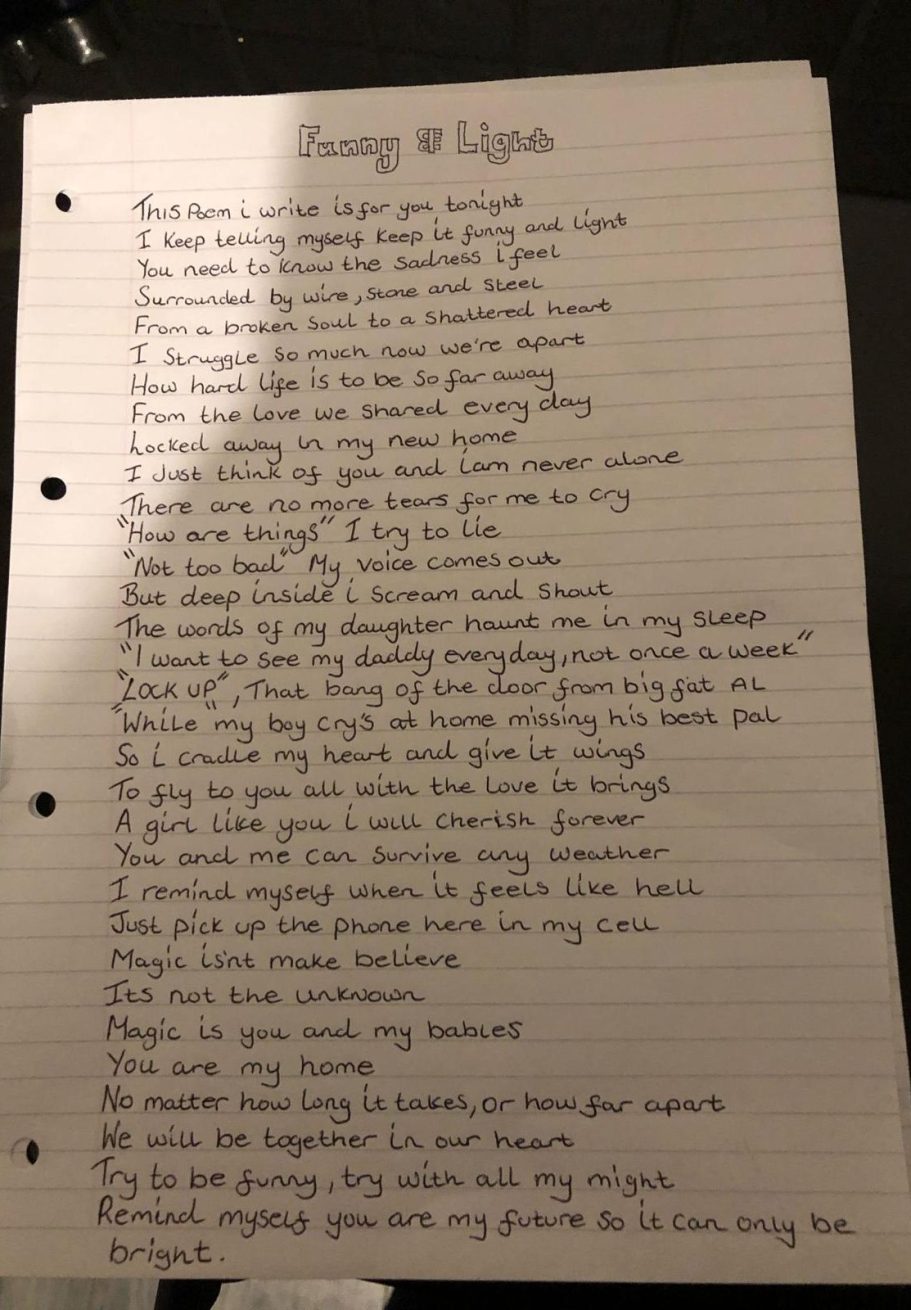

The #MeToo Movement, Feminist Influence, and the Broken Justice System in Scotland:A Wife’s Perspective
In 2017, the #MeToo movement exploded globally, drawing attention to the sexual harassment and assault that so many women face. What was initially a powerful call for justice, has, over time, become entwined with a shift in Scotland’s judicial practices when it comes to sexual offences. As the wife of a wrongfully imprisoned man, I have seen how these changes in the legal landscape have not only affected my family but also contributed to a broken system that now throws innocent men in prisons. This shift has been largely driven by the increased influence of feminist organizations like Women’s Aid and Refuge, who, along with the SNP, have helped shape the legal climate in ways that have distorted the search for justice.
The #MeToo movement laid the groundwork for greater sensitivity to sexual offences, but over time, it became a tool that was used to alter legal frameworks in a way that has eroded fundamental human rights of men. What began as a movement to support victims has turned into a political and legal force that, when combined with the aggressive application of the Moorov Doctrine and Sections 274 and 275, has led to serious miscarriages of justice.
The Rise of Feminist Influence: How Changes Began to Align
As the #MeToo movement gained momentum, feminist groups became more vocal in their demands for justice for survivors. But with that influence came changes to the legal landscape in Scotland that I now see were dangerous. The SNP, seeking to align with these groups, embraced the push for policies that would increase the conviction rates in sexual offence cases. But what no one seemed to care about was the impact this would have on the fairness of trials and the way evidence was treated in court.
The first key change began to take shape in 2017 when Lord Carloway’s review of the Scottish justice system recommended abolishing corroboration in sexual offence cases. Though this was met with opposition, it signaled a shift toward weakening the safeguards in the legal system - particularly in relation to sexual offences. The push to remove corroboration was about making it easier to secure convictions, but what it ignored was the protection that corroboration had historically provided to ensure that the accused were not wrongfully convicted. This was the first sign that the system was being altered in a way that would benefit political and activist agendas, rather than justice.
The Expansion of Moorov: A Legal Tool Turned into a Weapon
Following Carloway’s review, the Crown Office began increasingly relying on the Moorov Doctrine, a legal principle that allows allegations from different people or incidents to be linked together as part of a "course of conduct." This principle, originally designed for cases where there was direct corroboration, started to be used aggressively, particularly in sexual offence cases where there was no concrete evidence to support the claims.
By 2018, the use of Moorov had expanded rapidly. Allegations that had once been considered too weak to prosecute were now being linked together under this doctrine. The time gaps between the alleged incidents began to grow longer, and prosecutors started to present these allegations as part of an overarching pattern, even when the connections between them were vague. The doctrine, which was intended to be a safeguard against wrongful convictions, was now being used as a tool to secure convictions despite a lack of hard evidence.
In 2019, as high-profile sexual offence trials began to dominate the headlines, the use of Moorov in these cases became routine. The absence of corroborative evidence, once a major obstacle to a conviction, became less important. Courts were increasingly willing to accept multiple accusations, presented under the guise of a “pattern,” as sufficient grounds for conviction. This marked a critical turning point, as the Scottish justice system’s focus shifted from safeguarding the rights of the accused to securing convictions at any cost.
The Role of Feminist Organizations and Police: Shaping the Narrative and Coaching Accusers
While these shifts were unfolding in the courts, feminist organizations (I will mention here Women’s Aid and Refuge, due to personal experience, but there's more) were gaining increasing power and influence over public discourse and policy. These organizations, which initially provided vital support to survivors, began to exert more direct influence over the legal process itself. I know from experience that they have coached women on how to present their testimonies in court, providing guidance on what to emphasize and what to leave out. This guidance is framed as support for survivors, but it is clear to me that it has become part of a broader effort to ensure convictions, regardless of the facts.
Erin Pizzey, the founder of Refuge, walked away from the organization in 2019, citing her disillusionment with the toxic and politicized environment that had overtaken the group. Her departure was a stark reminder that what had started as an effort to help victims of domestic violence had become a politically charged movement that, in most cases, was more interested in achieving political outcomes than in providing fair support for the real victims.
But it doesn’t stop there. I also know that police are actively involved in coaching accusers, sometimes going back multiple times to change their statements and alter key details. Dates, times, and other crucial facts have been modified to fit the desired narrative. This isn’t just an isolated incident - it has become a pattern in many cases. Police officers are pushed by their superiors to achieve conviction targets (?!) and as a result they will often pursue any man - working with accusers to refine their testimonies, altering timeframes and details to ensure the accusations line up with the charges. This is a disturbing abuse of power, as it undermines the integrity of the entire investigation, trial process and police force in general.
The Dangerous Role of Sections 274 and 275
In addition to the influence of the #MeToo movement and feminist groups, there has been a noticeable increase in the use of Sections 274 and 275, which relate to evidence of a "course of conduct" in sexual offence cases. These sections, when used in combination with Moorov, have made it even easier to secure convictions in cases where the evidence is weak or non-existent, giving prosecutors the ability to bring together multiple, disparate accusations to create a narrative that is often not rooted in truth and the jury will never hear/see the full picture, only what suits the prosecution's narrative.
As the courts began relying more heavily on these tools, it became clear that the legal system was moving further away from the principle of "beyond a reasonable doubt" in favour of securing convictions. It’s no longer about ensuring that the accused is guilty based on concrete evidence - it's about using any means necessary to convict, even if that means stretching the law to its breaking point. This is not justice - it’s a system built to meet political and activist goals, rather than the pursuit of truth.
The Disgusting Trend of "Victimhood" for Attention and Money Making Machine
In the wake of these changes, it has also become increasingly frustrating and downright disgusting to see how some women have begun to exploit their alleged victimhood for attention and personal gain. Take the most recent example of Ellie Wilson - someone who seems to believe that posing for photos and posting it all over social media somehow makes her 'empowered'. All it does, however, is reassure me that she is more interested in likes and attention than actually addressing the real issues Real Victims face. This kind of performative victimhood is a slap in the face to those who have genuinely suffered and are seeking justice. And while Wilson's disgusting behaviour is out in the open for everyone to see, let's not forget about the 5000 other Scottish women who made compensation claims and £50 million spent by the Scottish government in the last 5 years alone. It is troubling to see how, for some, being a victim has become a commodity - a way to gain fame or make money, rather than a painful experience that demands respect and a fair process.
The Impact on My Family and the Broken System
As a result of these combined shifts in the legal and political landscape, innocent people - like my fiance (I call him my husband, but on the day we were meant to get married, he was giving evidence in court and we never actually got to say I do) - have found themselves wrongfully imprisoned. The aggressive use of the Moorov Doctrine, combined with the erosion of safeguards like corroboration and the influence of Sections 274 and 275, created an environment where allegations, regardless of their strength or evidence, can be treated as irrefutable facts. My husband’s wrongful conviction not only broke the lives of our whole family, but also opened our eyes to how deeply broken the system has become and that truth holds no meaning in court. The way the courts now operate has shifted away from a search for truth and toward a system that is focused on securing convictions, at all cost.
Courts are now more likely to accept historical allegations, even those separated by decades, and treat them as evidence of a pattern. This has left innocent men vulnerable to conviction based on nothing more than uncorroborated false allegations, from women looking for money or fame. The legal system has become a tool to achieve political and activist agendas, rather than a space where justice is fairly sought.
Conclusion: A Shift That Has Gone Too Far
What I have learned through my husband’s wrongful imprisonment is that Scotland’s justice system has undergone a fundamental transformation over the past few years - one that has undermined the very principles of fairness and due process. The influence of the #MeToo movement, combined with the increasing power of feminist organizations and the aggressive application of the Moorov Doctrine, Sections 274 and 275, has led to a system where innocent men are being convicted without solid (very often any), corroborative evidence. This is not justice; it is quite the opposite - it's a miscarriage of justice.
The changes that began in 2017 with the Carloway Review and were solidified in subsequent years have broken the system that was once designed to protect the innocent. My husband’s case is just one of many where the outcome has been determined by political and activist agendas rather than the pursuit of truth. It is time to demand a return to a justice system that protects the rights of all individuals, that ensures fair trials, and that holds perpetrators of all genders accountable. Only then can we rebuild trust in a system that has been irrevocably damaged.